Look at local discovery
If Maps and local-result visibility matter heavily in your market, your Google Business Profile deserves serious attention.

Google Business Profile and website SEO solve different parts of local search. Your profile helps customers discover and evaluate the business directly in Google Search and Maps, while your website gives you more space to explain services, locations, expertise and why someone should choose you. For most established local businesses, the strongest strategy connects both instead of treating them as competing channels.
The useful question is not “Which one is SEO?” Both can contribute to local visibility. The better question is where your current customer journey is weak and which asset gives you the strongest opportunity to fix it.
A Google Business Profile can put important business information directly in front of a nearby searcher. A website can explain the offer in much greater depth, support multiple services and locations, and give customers more evidence before they contact you.
If Maps and local-result visibility matter heavily in your market, your Google Business Profile deserves serious attention.
If customers need detailed information about several services, conditions, locations or use cases, website SEO gives you more room to build that relevance.
Reviews may influence a decision on the profile, while your website can add deeper proof, service detail, FAQs, credentials and clear conversion paths.
Customers often move between Google Search, Maps, your profile and your website. The experience should remain consistent across all of them.
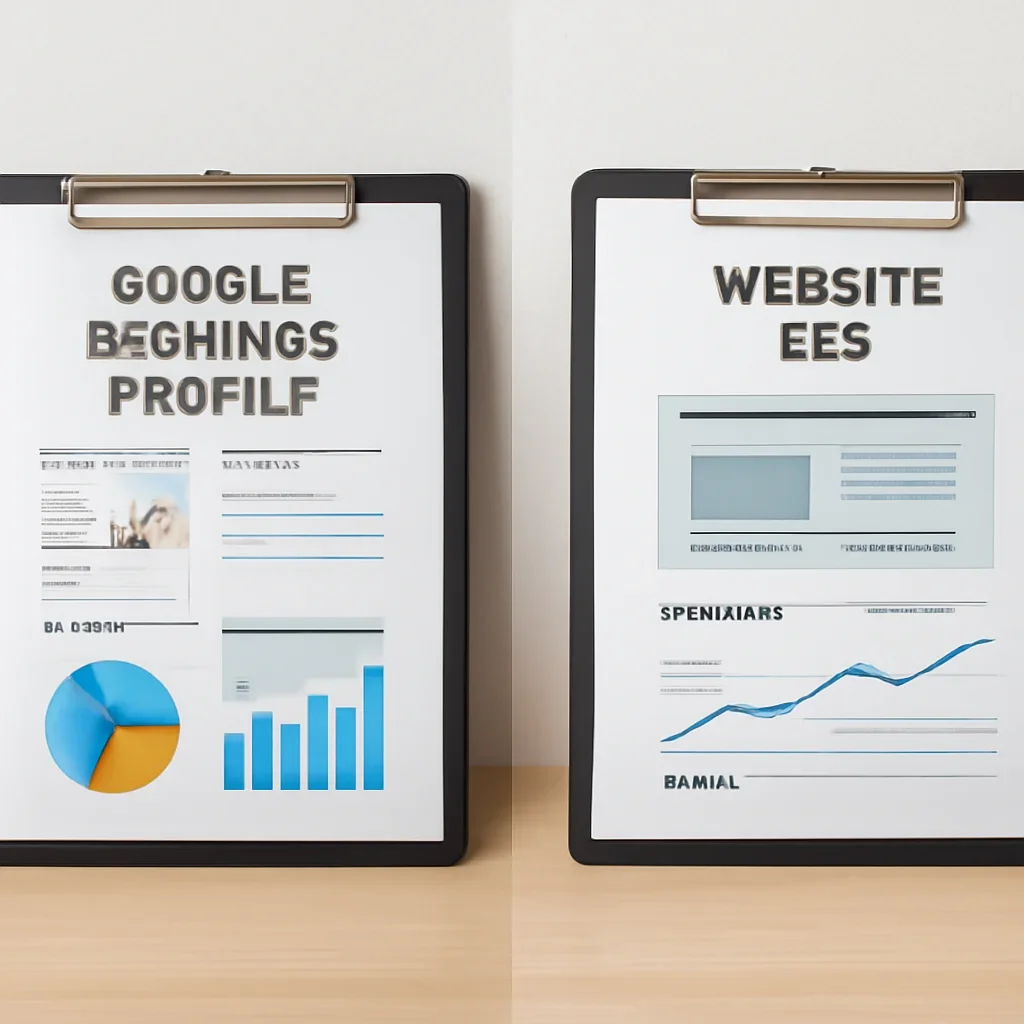
Google Business Profile is built around concise business information and local customer actions. Website SEO gives you far more control over how services are explained, how locations are connected, how expertise is demonstrated and how visitors move toward a call, booking or enquiry.
Each plays a different role. The stronger choice depends on what you are trying to improve right now.
| Area | Google Business Profile | Website SEO |
|---|---|---|
| Primary role | Help local searchers discover, evaluate and contact the business through Google Search and Maps. | Build searchable service information, location relevance, authority and conversion-focused landing pages. |
| Google Maps | Very important. The profile is the core business presence connected with Maps. | Supports the broader local presence by clearly explaining services, locations and business information. |
| Organic search | Can appear within local Google experiences, but it is not a replacement for searchable website pages. | Core strength. Individual pages can target different service, location and informational search needs. |
| Service detail | Useful for summarizing categories, services and basic business information. | Much deeper. Dedicated service pages can explain scope, process, FAQs, proof and related needs. |
| Location coverage | Represents the business's legitimate location or service-area setup. | Can support real geographic markets with useful, distinct location content where appropriate. |
| Reviews | Major strength. Customer reviews are prominently associated with the business profile. | Can reinforce reputation with relevant testimonials, case studies, credentials and supporting proof. |
| Content control | Structured around the fields and features Google provides. | High control. You control page structure, messaging, internal links and conversion experience. |
| Conversion options | Supports direct actions such as calling, getting directions or visiting the website where applicable. | Supports deeper conversion journeys including service-specific CTAs, bookings, quote requests and supporting information. |
| Best use | Local discovery, Maps presence, reputation and immediate business information. | Service depth, organic visibility, scalable content, authority and conversion. |
GBP deserves early attention when basic profile information is incomplete, the business is poorly represented in Maps, important categories or services are unclear, reviews need attention or customers rely heavily on immediate local information.
Website SEO becomes especially important when key services do not have strong pages, location content is thin, the site cannot answer customer questions, organic visibility is weak or relevant visitors are reaching pages that do not convert well.
There is no universal order for every business. These scenarios can help identify where the first round of work is likely to be most useful.
Fix core profile information first so customers are not evaluating the business through missing or conflicting details.
Start with GBPReview the profile, local relevance, website support, citations, reviews and other local signals rather than changing one field in isolation.
Start with local auditBuild or improve the website pages needed to explain those services and match the searches customers use when researching them.
Start with website SEOReview the landing-page experience, service clarity, trust signals and CTA placement before assuming more visibility will solve the problem.
Start with websiteBuild a coordinated system for profiles, location pages, listings and reporting rather than optimizing each channel separately.
Work on bothAudit the entire local search setup and prioritize foundational issues before investing heavily in isolated tactics.
Audit firstCustomers may discover you in Maps, move to the website for more detail, return to the profile to check reviews and then call. Every step should reinforce the same business identity, services and geographic coverage.
Important services represented on the profile should be clearly supported by useful website content where appropriate.
Addresses, service areas, phone information and other important business details should not create contradictions between channels.
When a potential customer moves from Google to the website, the page should immediately continue the same service and local context.
Reviews, business information, website content and genuine proof should work together to make the business easier to evaluate.
Look at local visibility and customer actions together instead of judging the profile and website through completely separate scorecards.
The exact sequence depends on the business, but a structured review prevents time being spent optimizing one channel while major problems remain elsewhere.

If your profile is weak, fixing website copy alone may not solve local discovery. If the profile is strong but customers land on thin or confusing service pages, more Maps visibility may simply send more people into a weak conversion experience.
Share your business type, service area and current local search challenges. We can review the setup and help identify whether Google Business Profile, website SEO or both should be prioritized.
The answer usually depends on the business's current weaknesses rather than one channel being universally better.
They serve different purposes. Google Business Profile is especially important for local discovery through Google Search and Maps, while website SEO supports deeper service content, organic visibility, location relevance and conversion. Most established local businesses benefit from improving both and prioritizing whichever currently has the larger gap.
Start with Google Business Profile when important business information is incomplete or inaccurate, Maps visibility is a major concern, reviews need attention, or customers rely heavily on immediate local information when choosing a provider.
Website SEO deserves priority when important services lack useful pages, location content is weak, organic visibility is limited, visitors cannot find enough information to make a decision, or the site attracts traffic without converting it effectively.
Yes. The profile can introduce the business through local Google experiences while the website provides deeper information about services, locations, expertise and next steps. Keeping the information aligned creates a clearer customer journey.
An eligible business can maintain a Google Business Profile without relying on a full website, but a website gives the business much greater control over service information, organic search content, location pages, proof and conversion experiences. The right setup depends on the business and its goals.
Website content can support a clearer overall local presence by reinforcing business services, geographic relevance and consistent information. Google Maps performance should still be treated as a broader local SEO issue rather than assuming one website change will determine visibility.
Reviews are especially prominent on Google Business Profiles and can strongly influence how customers evaluate a local result. Your website can complement that reputation with other credible proof such as testimonials, qualifications, project information, case studies or detailed service content where appropriate.
Important services often benefit from dedicated pages when there is enough useful information and distinct search intent to justify them. Creating separate pages merely to increase page count is less useful than building clear, meaningful service coverage.
Review the entire local search journey: profile accuracy, Maps visibility, service relevance, website structure, landing-page quality, reviews and customer actions. A local SEO audit can help identify whether the largest problem is profile visibility, website relevance, conversion or a combination of several issues.